What is atomCAT and why is it important?
Anal cancer is a relatively rare cancer, which means that any one hospital only sees a limited number of patients. This can make it difficult for researchers to collect enough information to develop accurate prediction tools and improve treatment decisions.
The atomCAT consortium brings together hospitals and research centres from multiple countries to tackle this challenge. Instead of sending identifiable patient data to a central database (rare medical conditions make patients easier to identify) , atomCAT uses an approach called federated learning, which allows researchers to work together while keeping patient information securely within each hospital.
What is federated learning?
A simple way to think about federated learning is to imagine a group of hospitals each studying their own patient data locally.
Rather than sharing sensitive patient records with one another, each hospital helps train a computer model on its own data. The hospitals then share only the lessons learned by the model, not the patient information itself. These lessons are combined to create a stronger prediction model that benefits from the experience of all participating centres.
This means researchers can learn from many more patients while maintaining privacy and meeting data protection requirements.
What did the atomCAT study show?
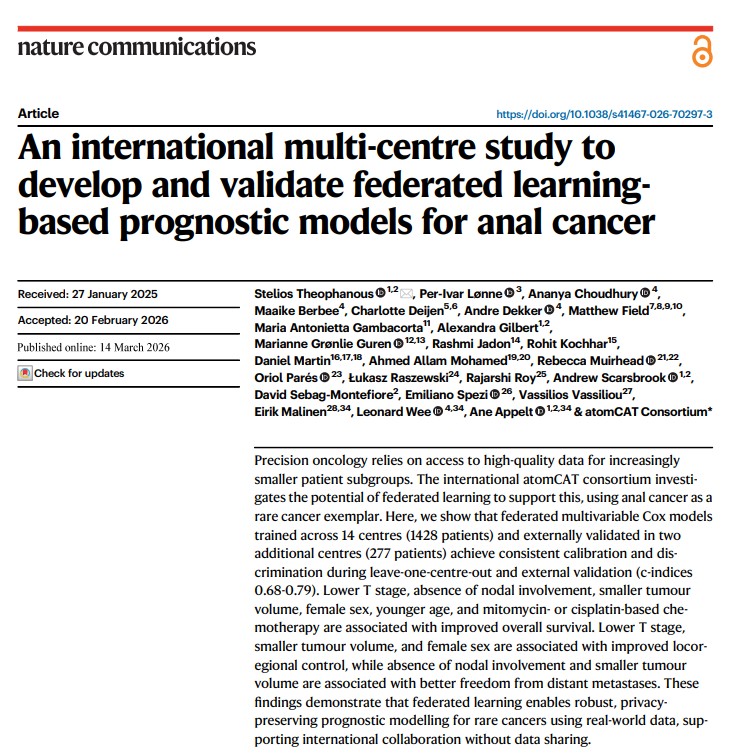
The Nature Communications paper explains how researchers from 16 centres across nine countries collaborated to develop and test prediction models for patients with anal cancer. The models were trained using data from more than 1,400 patients and then tested in additional centres to see how well they worked in real-world settings. This work represents the largest global real-world anal cancer radiotherapy dataset and has delivered validated prognostic clinical outcome prediction models. This RadNet work is influencing government health policy: atomCAT was cited in a House of Lord’s debate on the Rare Cancers Bill.
The study showed that federated learning can successfully create reliable prediction models without hospitals needing to share individual patient data. The models identified factors associated with patient outcomes, such as tumour size, cancer stage, age, sex, and treatment received